A queue that did not exist five years ago
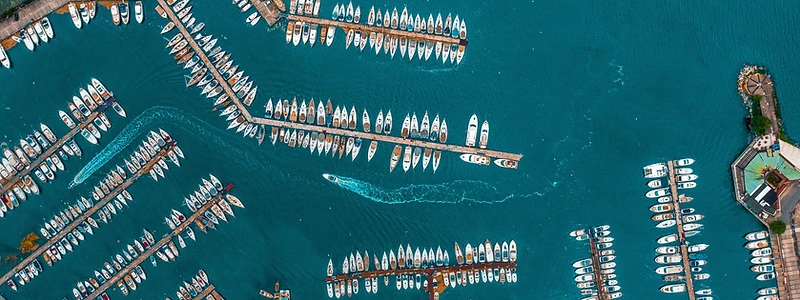
Late on a Friday afternoon in early September, the pontoons at Gouvia on Corfu are as full as they get. White hulls sit mast to mast across roughly 200,000 square metres of protected water, the former site of a Venetian shipyard, now a marina with berths for around 1,300 craft. On a good day there is barely a spare finger pontoon, let alone a spare slot.
"We normally have three to four boats inquiring for one berth," says Oliver Dörschuck, chief executive of D-Marin, which owns Gouvia and more than twenty other marinas across the region.
That single sentence explains a market that has quietly become one of the most interesting in yachting.
More boats, not more berths
The Mediterranean is the capital of the yachting world, with roughly a thousand marinas along its coastlines, of which about 400 are what the industry calls premium: deep enough, secure enough and well enough connected to take larger vessels. The problem is that the fleet these marinas serve keeps growing.
The number of yachts over twelve metres, the point at which a boat stops being something you store on land, has climbed to around 210,000 worldwide, and the growth has been concentrated in exactly the size brackets that need a proper berth and a proper marina behind it. Meanwhile the supply of berths has moved at the pace of coastal planning permission, which is to say barely at all.
Building a marina is not like building a car park. You need a stretch of sheltered coastline, a concession from the state or municipality that owns the water, an environmental assessment that will be scrutinised for years, and a local political consensus that rarely survives an election cycle. Wherever the coastline is already developed, the best sites are gone. Wherever it is not, the approvals are hardest to obtain.
Scarcity has changed the conversation
Josephine De Luca, who runs an independent consultancy representing yacht owners, says that before the pandemic brought a wave of new buyers into the market, finding a berth for a client at Port Vauban in Antibes was routine. It is not routine now.
"It's actually about scarcity now, for me that's really key," she says. "Berthing, it's not just more expensive but because the yachts are bigger and there's a finite amount of berths, the bigger change is being able to get the berth you want."
That distinction matters more than it sounds. Yacht owners are used to solving problems with money. A berth is not a problem money solves on its own, because the constraint is physical and administrative, and the vacancy is often held by someone with no intention of giving it up.
From dockage to asset class
Capital noticed. Earlier this year D-Marin was sold by its private equity owner CVC to the French infrastructure investor InfraVia for more than one billion euros, in an auction that drew interest from a long list of bidders. Infrastructure money likes marinas for reasons that are easy to understand: long leases, recurring annual contracts, high occupancy, inflation-linked pricing and customers whose vessels are worth far more than the fee.
The sector is still fragmented, with few genuinely large operators. Industry executives expect further consolidation. For owners, that is a mixed blessing: better facilities and more consistent service, but a counterparty with real pricing power and a portfolio view of who gets the best berths.
What it costs to stay put
Berthing fees in the most sought-after locations have roughly doubled over the past decade, and the 2026 tariff books show exactly where that leaves an owner.
Port Vauban in Antibes, the berth Josephine De Luca remembers as straightforward before the boom, publishes a 2026 visitor rate of €75.48 a day in the main season and €37.76 off-season for a 15-metre monohull, VAT included, dropping to €67.94 and €33.98 for stays of 30 days or more. At the standard rate that is roughly €13,800 for a single May-to-October season, for a mid-size boat, in a port where annual contracts carry a waiting list.
Spain shows how wide the spread has become. A 2026 annual berth for the same 15-metre monohull runs from about €8,000 in Cartagena or Almerimar to €9,000–€14,000 in Valencia, €20,000–€30,000 in central Palma, €25,000–€45,000 in Ibiza and €30,000–€55,000 in Barcelona — and that excludes metered electricity and water, which add €200–€500 a month. Catamarans and other wide-hulled boats pay a beam multiplier of 1.5 to 2 times in premium ports.
The pattern is not uniform. In Croatia, average daily rates rose 10 to 11 per cent into 2026 while annual contracts fell about 6 per cent, as marinas worked to hold occupancy after a softer season. In the contested western Mediterranean hubs the direction is one way. Annual contracts are no longer a simple service charge but a positional asset, and in parts of the Balearics and the Costa del Sol the only way to secure a premium berth is to buy the concession to it outright, accepting that the asset decays as the port's lease runs down. At the top of the scale, a 55-metre yacht in the most expensive European ports runs into several thousand euros a night in high season.
For a prospective buyer, the practical consequences are worth spelling out:
- Length and beam are the whole equation. A vessel a metre or two over the standard berth band can lose access to an entire class of marina. Check the berths available at your intended home port before you fall in love with the boat.
- Ask who holds the berth, and whether it transfers. A berth attached to a vessel, or to a lease held by the seller, changes the economics of the deal.
- Seasonal is not annual. Waiting lists for annual contracts at premium marinas commonly run for years; seasonal and transit berths are easier, and priced accordingly.
- Home port drives running costs. Ferry links, crew travel, provisioning and yard access all feed into the annual budget long before fuel does.
The supply that is coming, slowly
New capacity is being built, but not quickly enough to change the picture. Concession renewals across Italy and Greece are unlocking investment in existing ports. Montenegro and Croatia have added premium capacity on the Adriatic. The Gulf is building superyacht marinas from nothing at a speed Europe cannot match, though the distances involved mean most Mediterranean-based owners will not relocate.
The realistic outlook is a market that keeps tightening for the largest vessels in the most desirable ports, while capacity for mid-size boats improves modestly. Scarce berths do not lose value in a downturn. They simply become the reason a buyer chooses one yacht over another.
What we take from it
For anyone buying or selling, the berth is no longer an afterthought at the end of the paperwork. It is one of the few genuinely scarce things in yachting, alongside a good hull, a well-run yard and a broker who tells the truth. A vessel with a secure, transferable home port is worth more than the same vessel without one, and the market is only beginning to price that in.
YachtCrest lists yachts by location and by length overall for exactly this reason, and saved searches will tell you when a vessel appears in the region you intend to keep her in.
Fee figures are from published 2026 marina tariffs, including Port Vauban's 2026 tariff and conditions and 2026 Spanish marina rates. This piece also draws on reporting in the Financial Times on marina capacity and demand (FT Wealth, October 2026), alongside YachtCrest's own market analysis.